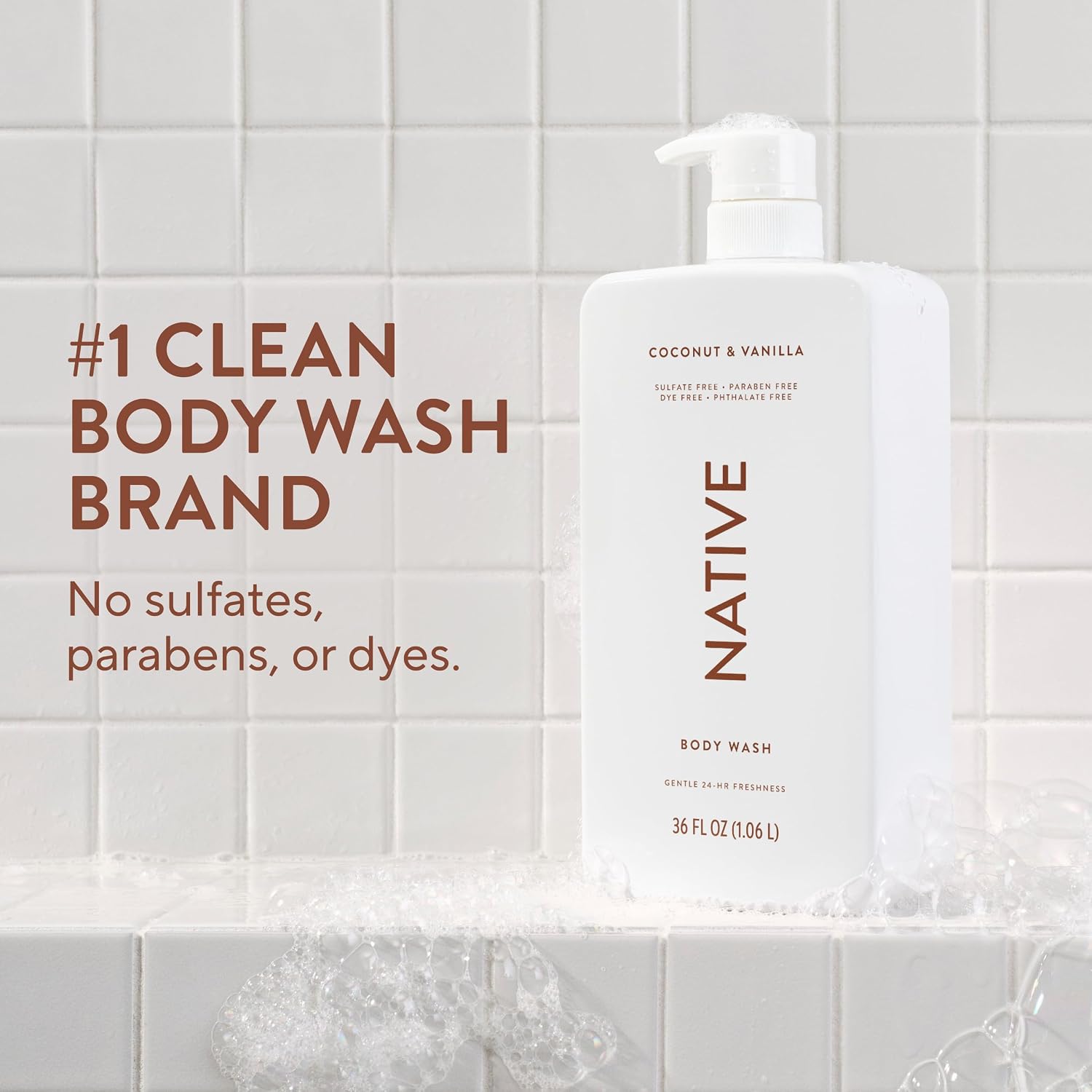
You’re standing in the shower aisle — or, more likely, scrolling a product page at midnight — trying to decide whether a $42 body wash is a reasonable purchase or a small act of financial self-destruction. The $10 bottle next to it has roughly the same claims on the front label: “moisturizing,” “gentle,” “leaves skin soft.” So what exactly are you paying for when you go premium? And more importantly, does it work out to more money per shower, or less?
Price-per-wash (sometimes called cost-per-use) is a straightforward calculation: you divide the total price of a product by the number of times you can realistically use it before it runs out. It’s the same logic you’d apply to a paper towel roll or a box of laundry pods — but most of us never apply it to body wash, because the bottle sizes look similar and the math seems tedious. It isn’t. And once you run the numbers, the $42 option sometimes wins. This article walks through the math, explains what actually drives that number (hint: it’s mostly about concentration and how much you pump per shower), and gives you a clear decision framework for your own routine.
The Math Is Simple. The Variables Are Not.
The formula itself takes about ten seconds:
Price ÷ Number of Washes = Cost Per Wash
The hard part is estimating “number of washes” accurately, because that depends on three things most labels never tell you: bottle volume, product concentration (how much active cleansing ingredient is in the formula versus water and filler), and your own dispensing habits.
Let’s anchor on some real-world numbers.
By the numbers — two representative formulas:
| Product | Price | Volume | Est. Washes | Cost Per Wash |
|---|---|---|---|---|
| Budget body wash (e.g., comparable to Everyone 3-in-1) | $10 | 32 oz (946 mL) | ~95 washes* | ~$0.11 |
| Prestige body wash (e.g., comparable to Nécessaire The Body Wash) | $42 | 16.9 oz (500 mL) | ~85 washes* | ~$0.49 |
Estimated at ~10 mL per wash for the budget formula (thinner viscosity, higher pour rate) and ~6 mL per wash for the prestige formula (thicker, more concentrated, lower dispensing volume). See methodology below.
At face value, $0.11 vs. $0.49 looks like a blowout win for the budget wash. But that estimate collapses if the concentrations are dramatically different — and they often are.
Concentration Is the Hidden Variable That Changes Everything
Here’s the piece that most price comparisons skip: not all body wash is equally concentrated. A budget formula might be 70–80% water (listed as “aqua” — always the first INCI ingredient when it dominates), with the rest being a fairly lean surfactant blend (surfactants are the cleansing agents — the molecules that lift oil and dirt off skin and rinse them away with water). A prestige formula at the same price tier might run 55–65% water, with a denser, more complex surfactant and conditioning stack.
The Beauty Brains podcast has noted in multiple episodes (including Episode 211, “Does price predict performance in rinse-off products?”) that rinse-off products like body wash are among the hardest categories to evaluate by price, precisely because concentration and dispensing behavior interact in ways consumers can’t assess from a label. A thicker, higher-concentration formula requires less product per use. If you’re using 10 mL of a thin budget wash versus 5–6 mL of a dense prestige wash, the actual ingredient delivery per shower can be quite similar — even though the volume consumed is not.
EWG’s Skin Deep Database frequently shows the same surfactant actives (sodium lauryl sulfate, sodium laureth sulfate, cocamidopropyl betaine, sodium cocoyl isethionate) appearing in both drugstore and prestige formulas — what differs is the ratio, the supporting cast of conditioning agents, and whether secondary actives like niacinamide, ceramides, or botanical extracts are present at functional concentrations (meaning high enough to actually do something) or just for label appeal.
This matters to your cost-per-wash math because: a formula you use less of per shower stretches further, and a formula with functional actives may reduce your need for post-shower body lotion — a product that costs real money on its own.
The Lotion Offset: A Hidden Line Item in Your True Cost
If you’re already tracking ingredient labels, you’ve probably noticed something: premium body washes frequently include conditioning agents that budget washes omit. Ingredients like glycerin (a humectant — it pulls moisture into the skin), ceramides (lipid molecules that reinforce the skin’s barrier), or squalane (a lightweight emollient oil) shift a body wash from “cleanser only” into partial moisturizer territory.
Reviewers at Byrdie, in their updated 2025 body wash roundup, consistently note that users of richer formulas like Nécessaire’s The Body Wash or Osea’s Ocean Cleanser report needing significantly less follow-up body lotion. Healthline’s sensitive-skin body wash guidance, reviewed in 2024, similarly points to emollient-rich formulas as a practical strategy for eczema-prone skin — not because they eliminate moisturizer entirely, but because they reduce the urgency and quantity needed.
Run this through the math: if a $42 body wash reduces your body lotion consumption by even one bottle per three-month period — say a $22 lotion — that’s $88 annually in lotion savings offset against roughly $168 annually for the prestige wash (used daily). Your true net additional cost for going prestige drops from $128 to $40. That’s not nothing, but it reframes the decision entirely.
The honest counterpoint: this offset only works if the conditioning agents are present at functional concentrations, and most brands don’t disclose percentage breakdowns on the label. The best proxy is ingredient list position — ingredients are listed in descending order of concentration. If glycerin or squalane appears in the first five ingredients, it’s likely meaningful. If it’s buried after fragrance near the bottom, treat it as a cosmetic claim, not a functional benefit.
Where the Luxury Premium Actually Goes
Let’s be direct about what you’re paying for when you step up to $50–$120+ territory (Aesop, Susanne Kaufmann, Augustinus Bader, Grown Alchemist). Consumer Reports’ body wash buying guides have consistently found that performance in rinse-off products reaches a functional plateau well below the luxury price ceiling — meaning a $45 formula and a $90 formula are unlikely to cleanse skin meaningfully better than each other. What the premium buys, in roughly descending order of honesty:
1. Fragrance experience. Luxury formulas often use complex, natural fragrance or essential oil blends that budget and mid-range formulas can’t match on cost. If you’re fragrance-sensitive, this is actually a reason to avoid the premium tier, not embrace it — many luxury formulas lean heavily into botanicals and essential oils that are known sensitizers (linalool, limonene, eugenol). Fragrance-free buyers are almost always better served in the $12–$35 range from brands like Vanicream or Nécessaire’s fragrance-free line.
2. Packaging and ritual experience. An Aesop pump bottle is an object. It was designed to sit on a shelf and feel intentional. That’s a real value for some buyers — especially spa professionals and amenity curators sourcing for client-facing environments — and a waste for others.
3. Certified-organic or sustainably sourced raw materials. Brands like Susanne Kaufmann and Dr. Hauschka carry NATRUE or COSMOS certification on their formulas, which means the organic claims have been third-party verified. That certification costs money at the supply chain level, and it’s reflected in retail price. Paula Begoun’s Beautypedia ingredient research notes that certified-organic surfactants (like sodium cocoyl glutamate or decyl glucoside) are typically more expensive to source than conventional alternatives — the cost isn’t purely marketing.
4. Brand overhead and distribution margins. Some portion of every luxury price point is real: artisan-scale manufacturing, prestige retail placement, smaller production runs. Some portion is pure brand equity. There’s no clean way to separate them from the outside.
The Decision Framework: If X, Then Y
You’ve read the label, checked the certification, and compared it to similar formulas so you don’t have to spend another hour on INCI lists. Here’s how to apply it:
If your primary goal is clean, functional cleansing at minimum cost: A well-formulated budget wash in the $9–$15 range (comparable to Dr. Bronner’s Castile Liquid Soap or Everyone 3-in-1) delivers the core job. Watch for SLS (sodium lauryl sulfate) if you have sensitive or compromised skin — it’s the most stripping of the common surfactants. SLES (sodium laureth sulfate) is milder; glucosides (like coco-glucoside or decyl glucoside) are milder still.
If you have condition-specific skin (eczema, hyperpigmentation, chronic dryness): The functional-active argument is real, but concentrate your budget in the $25–$45 mid-range where you can get ceramide- or niacinamide-fortified formulas without paying for luxury packaging. Nécessaire and Osea sit squarely in this zone based on label analysis.
If fragrance-free is non-negotiable: Price tier is largely irrelevant — your filter is certification and ingredient list, not brand positioning. EWG Skin Deep and Credo Beauty’s clean standard are useful starting screens. Budget allocations above $35 rarely buy you meaningfully better fragrance-free formulas.
If you’re sourcing for a professional or hospitality context: The $50–$120 tier earns its place — the packaging, scent architecture, and brand recognition deliver measurable client-experience value that cheaper formulas don’t replicate. Run the true cost-per-use math against your volume discount and refill program options (Aesop and Susanne Kaufmann both offer trade pricing) before committing at retail.
If the math still feels tight: A 16 oz prestige formula used at 5–6 mL per wash lasts approximately 90 days for a solo user. That’s $0.47/day for a mid-tier prestige product. A daily habit with meaningfully better skin outcomes isn’t an unreasonable line in a personal care budget — but only if the formula earns it on the label. If the conditioning actives are cosmetic-claim depth, you’re overpaying. If they’re functional-concentration depth, you may be breaking even against your lotion spend anyway.
The $42 bottle isn’t automatically a better or worse deal than the $10 one. What it is, once you run the numbers, is a knowable deal — and that’s the point.